



Two Paths. One Goal — A Good Life.
Understanding the Difference Between Electricians and Electrical Engineers
Every semester, students and families ask a version of the same question:
“Is engineering better than the trades?” It’s an understandable question, but it’s also the wrong one.
The real decision isn’t about prestige. It’s about timeline, debt, mobility, and the kind of life you want to build.
A recent MSN article highlighted high‑earning academic programs, including engineering, computer science, and business. These programs do offer strong long‑term earning potential. But the article also reminded us of something important:
There is more than one path to a high‑paying, meaningful career.
To help students think clearly, I often share a simple comparison between two respected roles in the electrical world: Electrician and Electrical Engineer.
Side‑by‑Side Comparison
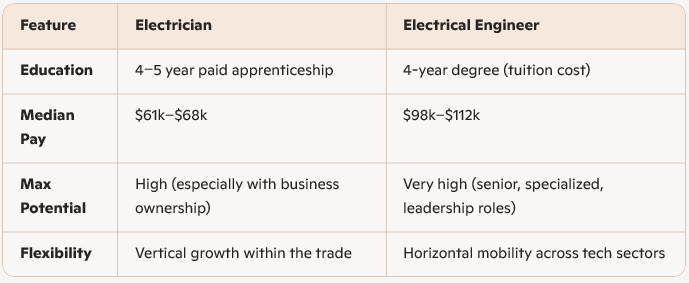
This table isn’t about ranking one path above the other. It’s about clarity, the kind that helps students make decisions with confidence rather than fear.
What These Differences Actually Mean?
- Time-to-Income – Electricians begin earning early. Apprenticeships are paid, and many students appreciate the ability to support themselves while learning. Engineers invest four years before entering the workforce, often with tuition costs. Their payoff tends to come later, but it is usually higher.
- Debt vs. Earnings Trajectory – Trades offer a low‑debt entry into a stable, respected profession. Engineering offers a higher long‑term ceiling, but with upfront financial investment. Both are valid. Both are strategic. The right choice depends on your financial reality and your appetite for delayed gratification.
- Entrepreneurship vs. Specialization – Electricians have a clear path to business ownership, a powerful wealth‑building opportunity for those with leadership instincts. Engineers have access to specialized roles across energy, automation, aerospace, manufacturing, and emerging technologies. Their mobility is horizontal, not just vertical. Both are valid. Both are strategic.
- Identity and Lifestyle – Some students thrive with hands‑on, physical, immediate work. Others are energized by design, analysis, and systems thinking. Neither identity is superior. Both build Canada. Both build families.
