


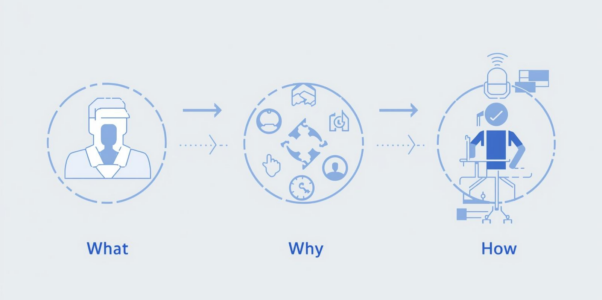
First the WHAT, Then WHY, Then HOW
A reset in how we think about RC circuits and phase angle. Last week gave us a perfect learning moment. Not because anyone was wrong, but because the sequence of thinking was out of order. We jumped straight to procedure, “Which probe goes where?” before understanding the concept that makes the procedure meaningful. This week, I want to reset our approach with a simple structure:
1. First, the WHAT
What are we actually measuring?
Before touching a probe, before choosing a voltage, before interpreting a waveform, we need to name the physical quantity at the heart of the experiment.
In an RC circuit, the phase angle is the relationship between:
• The source voltage, and
• The circuit current
If we don’t start with this WHAT, every procedural question becomes guesswork.
2. Then the WHY
Once we know what we’re measuring, we can ask:
Why do we measure Vr instead of Vc?
Because:
• Vr is in phase with the current
• Vc is 90° behind the current
• Therefore, Vc will always show 90° – Δ, not the actual phase angle
This is the conceptual anchor. Without it, both probe placements look plausible, even though only one reveals the true relationship.
3. Finally, the HOW
Only after the WHAT and WHY are clear does the HOW become obvious:
• CH1 → Source Voltage
• CH2 → Resistor Voltage
Not because it’s a rule to memorize, but because it’s the only configuration that measures the correct relationship.
Why this matters
When we start with the HOW, we end up debating procedures.
When we start with the WHAT, we end up understanding the circuit.
Last week’s skepticism wasn’t a problem; it was a signal. It told us we were ready to shift from “where do I put the probes?” to “what phenomenon am I actually observing?”
This week, we build on that.
