
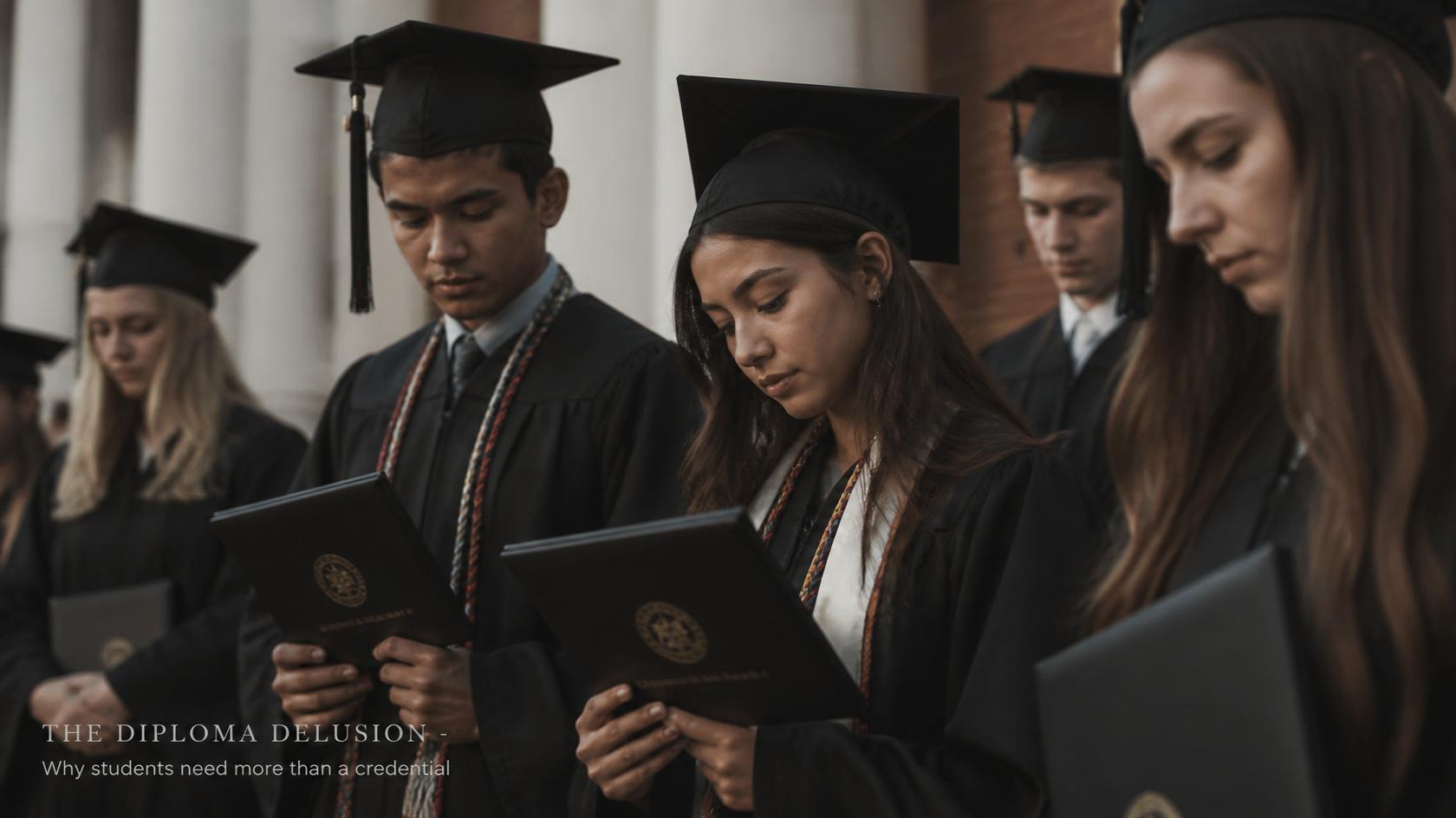

Why Students Need More Than a Credential to Build a Future
For years, students have been told a comforting story: “Get your diploma, and the job will follow.” But the labour market has quietly rewritten the rules. A diploma still matters — but not in the way students think.
Today, a diploma is proof of completion, not proof of capability. It shows that you attended, you passed, and you graduated. But employers are no longer hiring for attendance. They are hiring for thinking, adaptability, and evidence of growth.
This is the heart of the Diploma Delusion: Students believe the credential is the destination. Employers see it as the starting point.
And the gap between those two beliefs is where many graduates stumble.
1. The New Hiring Reality
Employers are overwhelmed with applicants who all look the same on paper. Same diploma. Same course list. Same generic résumé.
What separates one graduate from another is no longer the credential — it’s the soft skills that shape how a student thinks, behaves, and learns.
These six soft skills are now the real currency of employability:
2. The Six Soft Skills That Matter Most
Critical Thinking – The ability to analyze, question, and make sound decisions. Graduates who can think through a problem — not just follow instructions — rise quickly.
Emotional Intelligence – The maturity to communicate clearly, manage conflict, and read a room. This is what makes a young worker someone others want on their team.
The Self‑Taught Learner – The student who doesn’t wait for permission to grow. In a world where tools change monthly, this is the trait employers trust most.
Adaptability – Plans change. Systems fail. People leave. Graduates who can pivot without falling apart become invaluable.
Pattern Recognition – Seeing connections others miss — the foundation of diagnostics, troubleshooting, and innovation.
Resourcefulness – The ability to figure things out with limited information, time, or support. This is the difference between “I don’t know” and “I’ll find out.” These skills cannot be memorized. They are lived, practiced, and revealed through experience.
3. The Portfolio and Transcript: Evidence That You’re Growing
A diploma says, “I completed the program.” A portfolio says, “Here’s what I can actually do.” A transcript says, “Here’s the trajectory of my learning.”
Together, they tell a story employers can trust:
- What you’ve built
- How you think
- How do you solve problems
- How you’ve grown over time
This is what earns a graduate the interview.
Not the diploma alone — but the story behind it.
4. Steven’s Story: The Moment the Delusion Breaks
Steven did everything right. He worked hard, passed his courses, earned his diploma, and applied to the union. He believed the promise: “Graduate, and the job will follow.”
But the union said no.
That moment could have broken him. Instead, it revealed who he really was.
Steven didn’t collapse into bitterness. He didn’t blame the system. He didn’t cling to the delusion that the diploma guaranteed anything.
He used the six soft skills:
- Critical thinking: He assessed the situation honestly.
- Emotional intelligence: He didn’t take the rejection personally.
- Self‑taught learner: He kept building skills outside the classroom.
- Adaptability: He pivoted without drama.
- Pattern recognition: He saw the mismatch between promises and reality.
- Resourcefulness: He found another path forward.
Steven wasn’t behind. He was simply early in the story.
And that’s the truth students need to hear.
5. The Message to Students
Your diploma is not your identity. It is not your destiny. It is not the guarantee you were promised.
But it is the beginning of your story.
What employers want — what the world needs — is a graduate who can:
- think clearly
- communicate with maturity
- learn independently
- adapt under pressure
- see patterns
- solve problems
- and show evidence of growth
If you can do that, the diploma becomes powerful again — not as a ticket, but as a foundation.
6. What Employers Actually Look For
In my career, I reviewed hundreds of co‑op applications. And I can tell you this with absolute clarity:
I never hired the perfect résumé. I hired the student who showed intention.
A résumé got my attention. But intention got my recommendation.
Here’s what I looked for every single time:
- Did the student understand the company?
- Did they research our products, our customers, our work?
- Did their cover letter show alignment — not flattery, but purpose?
- Did they demonstrate soft skills through the way they communicated?
- Did their portfolio show evidence of curiosity, effort, and growth?
- Did their transcript show progress, not perfection?
Most students never knew this. They thought they were applying for a job. But employers are evaluating a future colleague.
And when a student connected their future to our work, that’s when they stood out.
Because in the real world, success looks like this:
[Diploma + Portfolio + Transcript + Soft Skills + Alignment] = Potential Employee
Once you understand how employers choose, the diploma delusion finally breaks, and the sequence that turns a graduate into a hire is unmistakable.
7. The Closing Reflection
The Diploma Delusion isn’t meant to discourage students. It’s meant to free them.
Because once you stop believing the diploma is the whole story, you can finally start writing the part that matters: the story of who you are becoming.
